Alright, for some reason listening to the AAR audio while I played Star Wars Battle Front lead me to some confusion. A 2.5 hour lecture is tough when you can't see the panel's beautiful faces, so I listened while electronically taking over the Death Star. Any way I thought I heard Scot tell Tony that he had a Swisher Sweet when he was outside smoking and just the mention of the cigar that should not be named bothers me. It is like a divinity student telling you their favorite 'translation' of the Bible is the Living paraphrase. BUT, I guess I did not have ears to hear Scot's true words quoted below. Scot displays just how a true emerging cigar smoker responds to the idea of a Swisher Sweets:
@23:50 into the conversation audio......
Scot is telling a story about reading a book and bird watching and Tony inerrupts with a question.
TOny: "Did you have anything in your right hand?
Scot: "Like a cigar?"
Tony: "yeah"
Scot: "I don't know, a good one. Not a cheap one like a Swisher Sweet,"
Amen Hallelujah.
My APOLOGY: Scot I am sorry for not listening well and questioning your emerging cigar status. It appears that with Blue Jeans, a real cigar, and the best blog out there you could be more emerging than Tony. Clearly you emerge past me who was distracted from listening to your voice well because of a violent video game and my radical othering of Swisher Sweets.
Wednesday, November 28, 2007

Tuesday, November 27, 2007
Emergent @ AAR Audio and Why Swisher Sweets are not Emerging....An aside for Scot McKnight
Andy Rowell is my new hero. As some of you know my wife is about to pop out our first child so I couldn't go to AAR this year and I missed the Process \ Radical Orthodoxy showdown and the Emergent Church panel with Tony Jones, Scot McKnight and Diana Butler Bass. Andy is from Duke so he didn't make it to see my favorite living Methodist theologian John Cobb bring the theological ruckus, but he did get the Paul and Empire audio and few other dialogical treasures. Go and listen.
I thought Scot's 6 questions were insightful and was proud to hear he rocked out the new Blue Jeans. Tony and DBB's squabble was humorous and I think it brought things out of both of them you wouldn't have seen otherwise. The only thing that really bothered me was Scot McKnight admitting to smoking swisher sweets. Swisher Sweets are for cigars what Boone's Farm is to wine. When he came to NC with Tony Jones he brought a travel humidor with 5 Hoyo De Monterey Excalibur #1s. While he was here we also had Rocky Patel vintage 1990's and Cuban Montecristo #3's(See here). Just how one could take such strides in their wardrobe and take so many steps back in their cigar choice is troublesome. Swisher sweets are processed, chemical infused, pseudo-tobacco. It is difficult to taste the tobacco when you smoke one but each one of them tastes the same. They are dry-cured and made by machines. Real cigars, authentic cigars, organic cigars are those that come from the earth to a craft workers' hand and to your mouth. A real cigar is made by God, the earth, and human beings (Ikons even). It is a piece of organic art. It tastes different depending on the soil, location of the plant, weather from the of growth, aging process and length, size of the cigar, blend of tobaccos, when you smoke it, how you cut it, light it, and who you smoke with. Real handmade cigars are emergent or emerging if you will. Swisher Sweets are what were are emerging from in the cigar world.
For those of you who have yet to experience a real cigar or join in an emergent conversation let me know and I will open my humidor of friendship for you and match a perfect cigar with a great cup of coffee and you will hopefully never find yourself smoking Swisher Sweets again. It appears I will need to mail Scot a Christmas gift on behalf of all emerging cigar smokers.
For some reason at every Q&A session with academics or church people atonement comes up. I have a theory some other emergent types should test out. If you bring up atonement and they freak out because the idea of a mosaic of atonement theories seems ludicrous then they are probably an evangelical. If on the other hand they look at you like you are Jerry Falwell the moment you act like atonement matters then you are probably talking to a mainliner. On that note everyone should read Scot McKnight's book on atonement and then try out the golf bag metaphor.
My Reflection from the last Dogwood Abbey Gathering
This is the reflection that started off the sermonic discussion at the last Abbey gathering. If you are interested go here and find it.
Monday, November 26, 2007
Book of Insight: "Rising from the Ashes: Rethinking Church"
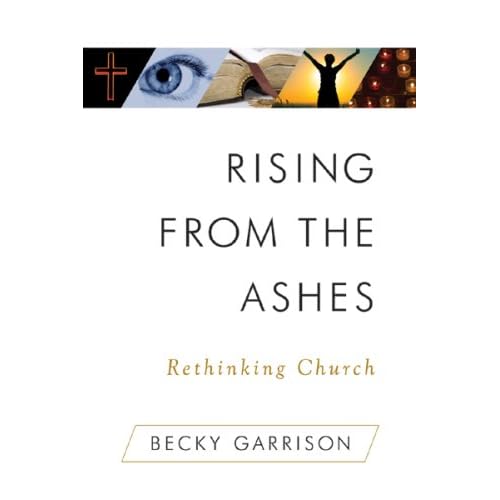
I just finished reading Becky Garrison's newest book 'Rising from the Ashes' and liked it so much I thought I would try to wet your appetite. This is the newest book in an emerging genre I call 'emerging church...wtf,' where the author has examined a host of emerging communities or people so that they can then offer a synthetic assessment of the movement. I have a number of those such books and I will be honest and say they can't keep my attention, so I put them down to read somePannenberg or Baudrillard . After reading Garrison's book I figured out that while a nice analysis where you can pick up a book and see an organized list of characteristics found in emerging churches is pleasant, it feels synthetic and not so emerging of an approach. The traditional book in the 'emerging church...wtf' genre ends up eliminating the particularities, the disagreements, the personalities, and relationships that make the movement refreshing, at least to me. Garrison may havetranscended the category because her book preserves the oddities of the divergent emerging voices she interviewed for the book. How did she do that you may ask? Good question, the book is a collection of interviews conducted through a variety of media (phone, AIM, blog, and in person) that are then organized around the themes of the ten chapters. There are interviews with big names like Diana Butler Bass, Tony Jones, NT Wright, and Phyllis Tickle but when you get done you won't remember much of what they said. The stars of the book are the host of people who are lesser known emerging practitioners and thinkers, who when placed beside the big names demonstrate just how much good stuff is missed by most books in the genre. A few things you will notice if you are smart enough to buy and read will be a high concentration of Episcopal voices, many of which sustain my favoriteconversation throughout the book - what do we do with the Book of Common Prayer. I am not Episcopal, Baptist in fact, but this discussion shows the diversity the emerging conversation can have on one issue and after taking it in you will not say this is what an emergent type would do with the Book of Common Prayer. You will also hear arguments over the role and proper function of technology, ritual, tradition, and innovation. You will read a book that is packed full of theology but not more than threesentences of theology that isn't practical and nothing practical in the book isn't treated as theology. The real reason you should get this book is because it has so many great quotes to steal or appropriate. When you read it you will be grateful that Garrison was a good member of the emerging movement and knew that the best way to get to the point is to keep asking good questions. Here are some zinger-of-a-quotes I found.
"Christianity at its core doesn't explain life, but it brings life."
"Like it or not, liberation has to happen for the oppressor, who is acting out of a place of fear and not liberation."
"We are political but not partisan. We're value driven but not ideological. We are civil but not soft. And we are involved, but we are not used or co-opted by other forces, be they government or commercial."
"Ritual is embodied participatory action."
"Ritual is what people consciously and deliberately choose to do again."
"The liturgy is our work, the work of the people. Now you get to listen closely to where God is calling us, and to bring that wisdom and insight to light in the worship that we all share."
"If you start with pure reason, you'll never get your heart fully enough involved to get down and change things."
"Anglican churches - need to become wombs of the divine - centered on transformative community centered on love and justice."
****My Favorite Question and Answer I couldn't edit****
Which population do you feel are especially drawn to these ancient spiritual practices, and why?
"Younger-than-Baby-Boomer folks: members of my own generation are stilled mired often in 'rebelling against the Establishment' and deconstructing beyond meaning every traditional image or resource. What Boomers don't get is that such zeal is not a universal - it is culturally conditioned and has hit itsexpiration date. Younger folk don't have any interest in gathering and hearing why they no longer have to believe the story-as-it-was-told-when-they-were-little. There is no more 'establishment' as envisioned by the 'Me-Generation.' All there is left is an economy, and a crushing array of people and forces willing and eager to sell everything to blocks of people identified as a 'demographic.' Churches of all ilk fall into this same anxious, predatory pattern of selling, and many denominations haveunapologetically adopted wholesale marketing techniques and called it 'evangelism.' Younger folk do not want Jesus sold to them as a commodity. they want a faith that is free and authentic and are open to manifestations of that faith that have stood the test of time and might throw a little light on an alienated and market-driven age."
Well all those quotes are from people who are not big names and those snippets are part of much larger and beautiful conversations. Go read it and enjoy. Thanks Becky for putting this together.
Saturday, November 24, 2007
The Cross and the Lynching Tree
Bill Moyers interviewed one of America's greatest theologians, James Cone. The interview was amazing and should be viewed in its entirety by all decent human beings in America. Because most of the world did not have James Dunn for Ethics in grad school and there developed an addiction to Bill Moyers I don't want to ruin the interview with my commentary but I would point you to how the connection of the cross and lynching tree would change Christian theology and practice in America.
GO WATCH IT HERE
Wednesday, November 14, 2007
Walter Lowe on understanding salvation
"On reflection, it is not self-evident that the best way to present the Christian Gospel - the good news - is to begin with the negative. If one begins by making a pact with the negative, so to speak, will that not color what comes after? Is there not the risk that, despite one's best intentions, the radical good of the Gospel will be endlessly deferred? That it will never stand forth in its own right?"
"Christ and Salvation" in The Cambridge Companion to Postmodern Theology, ed. by Kevin Vanhoozer (Cambridge University Press, 2003), 236.
The Return of the PoMo Negro "Applause!!"
My favorite theo-blogger is back in the saddle and if you know what is good for your eyes you will go see his newest series on CEO style leadership in faith communities. Anthony, blog author, is a very insightful and astute thinker who I am glad to call friend. Read on.
Subscribe to:
Posts (Atom)