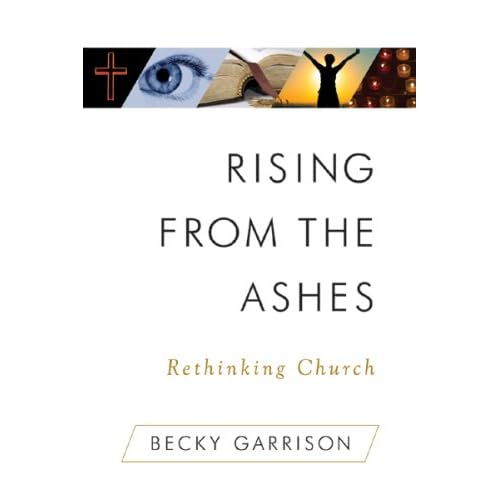
I just finished reading Becky Garrison's newest book 'Rising from the Ashes' and liked it so much I thought I would try to wet your appetite. This is the newest book in an emerging genre I call 'emerging church...wtf,' where the author has examined a host of emerging communities or people so that they can then offer a synthetic assessment of the movement. I have a number of those such books and I will be honest and say they can't keep my attention, so I put them down to read somePannenberg or Baudrillard . After reading Garrison's book I figured out that while a nice analysis where you can pick up a book and see an organized list of characteristics found in emerging churches is pleasant, it feels synthetic and not so emerging of an approach. The traditional book in the 'emerging church...wtf' genre ends up eliminating the particularities, the disagreements, the personalities, and relationships that make the movement refreshing, at least to me. Garrison may havetranscended the category because her book preserves the oddities of the divergent emerging voices she interviewed for the book. How did she do that you may ask? Good question, the book is a collection of interviews conducted through a variety of media (phone, AIM, blog, and in person) that are then organized around the themes of the ten chapters. There are interviews with big names like Diana Butler Bass, Tony Jones, NT Wright, and Phyllis Tickle but when you get done you won't remember much of what they said. The stars of the book are the host of people who are lesser known emerging practitioners and thinkers, who when placed beside the big names demonstrate just how much good stuff is missed by most books in the genre. A few things you will notice if you are smart enough to buy and read will be a high concentration of Episcopal voices, many of which sustain my favoriteconversation throughout the book - what do we do with the Book of Common Prayer. I am not Episcopal, Baptist in fact, but this discussion shows the diversity the emerging conversation can have on one issue and after taking it in you will not say this is what an emergent type would do with the Book of Common Prayer. You will also hear arguments over the role and proper function of technology, ritual, tradition, and innovation. You will read a book that is packed full of theology but not more than threesentences of theology that isn't practical and nothing practical in the book isn't treated as theology. The real reason you should get this book is because it has so many great quotes to steal or appropriate. When you read it you will be grateful that Garrison was a good member of the emerging movement and knew that the best way to get to the point is to keep asking good questions. Here are some zinger-of-a-quotes I found.
"Christianity at its core doesn't explain life, but it brings life."
"Like it or not, liberation has to happen for the oppressor, who is acting out of a place of fear and not liberation."
"We are political but not partisan. We're value driven but not ideological. We are civil but not soft. And we are involved, but we are not used or co-opted by other forces, be they government or commercial."
"Ritual is embodied participatory action."
"Ritual is what people consciously and deliberately choose to do again."
"The liturgy is our work, the work of the people. Now you get to listen closely to where God is calling us, and to bring that wisdom and insight to light in the worship that we all share."
"If you start with pure reason, you'll never get your heart fully enough involved to get down and change things."
"Anglican churches - need to become wombs of the divine - centered on transformative community centered on love and justice."
****My Favorite Question and Answer I couldn't edit****
Which population do you feel are especially drawn to these ancient spiritual practices, and why?
"Younger-than-Baby-Boomer folks: members of my own generation are stilled mired often in 'rebelling against the Establishment' and deconstructing beyond meaning every traditional image or resource. What Boomers don't get is that such zeal is not a universal - it is culturally conditioned and has hit itsexpiration date. Younger folk don't have any interest in gathering and hearing why they no longer have to believe the story-as-it-was-told-when-they-were-little. There is no more 'establishment' as envisioned by the 'Me-Generation.' All there is left is an economy, and a crushing array of people and forces willing and eager to sell everything to blocks of people identified as a 'demographic.' Churches of all ilk fall into this same anxious, predatory pattern of selling, and many denominations haveunapologetically adopted wholesale marketing techniques and called it 'evangelism.' Younger folk do not want Jesus sold to them as a commodity. they want a faith that is free and authentic and are open to manifestations of that faith that have stood the test of time and might throw a little light on an alienated and market-driven age."
Well all those quotes are from people who are not big names and those snippets are part of much larger and beautiful conversations. Go read it and enjoy. Thanks Becky for putting this together.