I am very pumped about the upcoming Deep Shift event here in NC. Brian McLaren is bringing an interactive experience with music, art, discussion, just coffee, and Brian speaking around the content of his newest and best book yet.
If you haven't read the book you should, but to tempt you I will point you to three appetite inducers.
- The Other Journal has a great, revealing, and down right fun interview to read. So go read it.
- The Emergent Village Podcast has an interview with Brian and Tony Jones. So go listen to it.
-Finally, if you haven't checked out Brian blogging at Table For One.....go blogger-read it.
My brother-in-law Cory, Steven (the bio-brother), and I are going to the event. It will be my first night of not going to bed at 7pm with the new baby so if you thinking about going, GO and I promise to go out until the early morning and discuss theology while we smoke fine cigars.
So if you are going to be there or are interested check out the Charlotte Deep Shift blog. If you haven't paid yet there is a discount code from our friends in the Emergent Village cohort in Charlotte.
Showing posts with label emergent. Show all posts
Showing posts with label emergent. Show all posts
Saturday, December 15, 2007

Wednesday, December 5, 2007
McLaren talking with secular fundies
I had three friends email me about Brian McLaren blogging this week at Table For One and so I checked it out. If you haven't read Brian's new book you will see him summarize himself well. Most importantly are the comments under each blog. If you want to see how to engage in religious dialog with a secular fundamentalist check it out. Brian always tells people that at his heart he is an evangelist and here I think we can see how an evangelist who
counts conversations and not conversions shares, listens, and responds. For all three of you who shared thanks.
counts conversations and not conversions shares, listens, and responds. For all three of you who shared thanks.
Wednesday, November 28, 2007
Emerging Left
The emergent conversation is full of honest and courageous conservative evangelicals who take the risk to say just what they are emerging from and why. When I talk with them or read things they write it is always refreshing to see such an honest and forward person reflecting and transforming their understanding of faith in light of their questions and journey. What has been less visible or audible in the conversation are those of us who are not emerging from the theological right, but the left. I think of myself as a member of the emerging left. Before entering the conversation you would have had trouble getting me to say much of anything with confidence theologically past Schleiermacher's 'Feeling of Absolute Dependence' or Tillich's 'Ground of Being or Being-Itself' or how like Borg I had seen Jesus again 'for the first time.' I still read and love those three (and I think Schleiermacher is more identifiably Christian than many enemies give him credit for). What I am going to attempt to do is articulate what it was like to theologically emerge from the left. Not that you can generalize my journey that is still in process for all the emerging left, but I am sure it will be easy enough to see how it differs and highlights different transformations than my sisters and brothers on the right.
Since the more progressive Christians are as diverse as the conservative ones it may be helpful for you to know that I am a progressive Baptist (yes we do exist), went to an ecumenical seminary, currently am employed at a Disciples of Christ church, have always lived in the Bible belt, am a preacher's kid, have been married 5.5 years to a wonderful female minister who grew up in a fundamentalist home, and have a kid arriving any day now. I guess you could say I am emerging left out of the south land. Well the first thing I am going to look at is the topic that creates the most tension in conversation with those emerging from the right, the Bible. I am thinking ofplayfully entitling it 'the Bible is not a salvage yard or a dead bunny.'
Since the more progressive Christians are as diverse as the conservative ones it may be helpful for you to know that I am a progressive Baptist (yes we do exist), went to an ecumenical seminary, currently am employed at a Disciples of Christ church, have always lived in the Bible belt, am a preacher's kid, have been married 5.5 years to a wonderful female minister who grew up in a fundamentalist home, and have a kid arriving any day now. I guess you could say I am emerging left out of the south land. Well the first thing I am going to look at is the topic that creates the most tension in conversation with those emerging from the right, the Bible. I am thinking ofplayfully entitling it 'the Bible is not a salvage yard or a dead bunny.'
Scot McKnight doesn't smoke Swisher Sweets
Alright, for some reason listening to the AAR audio while I played Star Wars Battle Front lead me to some confusion. A 2.5 hour lecture is tough when you can't see the panel's beautiful faces, so I listened while electronically taking over the Death Star. Any way I thought I heard Scot tell Tony that he had a Swisher Sweet when he was outside smoking and just the mention of the cigar that should not be named bothers me. It is like a divinity student telling you their favorite 'translation' of the Bible is the Living paraphrase. BUT, I guess I did not have ears to hear Scot's true words quoted below. Scot displays just how a true emerging cigar smoker responds to the idea of a Swisher Sweets:
@23:50 into the conversation audio......
Scot is telling a story about reading a book and bird watching and Tony inerrupts with a question.
TOny: "Did you have anything in your right hand?
Scot: "Like a cigar?"
Tony: "yeah"
Scot: "I don't know, a good one. Not a cheap one like a Swisher Sweet,"
Amen Hallelujah.
My APOLOGY: Scot I am sorry for not listening well and questioning your emerging cigar status. It appears that with Blue Jeans, a real cigar, and the best blog out there you could be more emerging than Tony. Clearly you emerge past me who was distracted from listening to your voice well because of a violent video game and my radical othering of Swisher Sweets.
@23:50 into the conversation audio......
Scot is telling a story about reading a book and bird watching and Tony inerrupts with a question.
TOny: "Did you have anything in your right hand?
Scot: "Like a cigar?"
Tony: "yeah"
Scot: "I don't know, a good one. Not a cheap one like a Swisher Sweet,"
Amen Hallelujah.
My APOLOGY: Scot I am sorry for not listening well and questioning your emerging cigar status. It appears that with Blue Jeans, a real cigar, and the best blog out there you could be more emerging than Tony. Clearly you emerge past me who was distracted from listening to your voice well because of a violent video game and my radical othering of Swisher Sweets.
Tuesday, November 27, 2007
Emergent @ AAR Audio and Why Swisher Sweets are not Emerging....An aside for Scot McKnight
Andy Rowell is my new hero. As some of you know my wife is about to pop out our first child so I couldn't go to AAR this year and I missed the Process \ Radical Orthodoxy showdown and the Emergent Church panel with Tony Jones, Scot McKnight and Diana Butler Bass. Andy is from Duke so he didn't make it to see my favorite living Methodist theologian John Cobb bring the theological ruckus, but he did get the Paul and Empire audio and few other dialogical treasures. Go and listen.
I thought Scot's 6 questions were insightful and was proud to hear he rocked out the new Blue Jeans. Tony and DBB's squabble was humorous and I think it brought things out of both of them you wouldn't have seen otherwise. The only thing that really bothered me was Scot McKnight admitting to smoking swisher sweets. Swisher Sweets are for cigars what Boone's Farm is to wine. When he came to NC with Tony Jones he brought a travel humidor with 5 Hoyo De Monterey Excalibur #1s. While he was here we also had Rocky Patel vintage 1990's and Cuban Montecristo #3's(See here). Just how one could take such strides in their wardrobe and take so many steps back in their cigar choice is troublesome. Swisher sweets are processed, chemical infused, pseudo-tobacco. It is difficult to taste the tobacco when you smoke one but each one of them tastes the same. They are dry-cured and made by machines. Real cigars, authentic cigars, organic cigars are those that come from the earth to a craft workers' hand and to your mouth. A real cigar is made by God, the earth, and human beings (Ikons even). It is a piece of organic art. It tastes different depending on the soil, location of the plant, weather from the of growth, aging process and length, size of the cigar, blend of tobaccos, when you smoke it, how you cut it, light it, and who you smoke with. Real handmade cigars are emergent or emerging if you will. Swisher Sweets are what were are emerging from in the cigar world.
For those of you who have yet to experience a real cigar or join in an emergent conversation let me know and I will open my humidor of friendship for you and match a perfect cigar with a great cup of coffee and you will hopefully never find yourself smoking Swisher Sweets again. It appears I will need to mail Scot a Christmas gift on behalf of all emerging cigar smokers.
For some reason at every Q&A session with academics or church people atonement comes up. I have a theory some other emergent types should test out. If you bring up atonement and they freak out because the idea of a mosaic of atonement theories seems ludicrous then they are probably an evangelical. If on the other hand they look at you like you are Jerry Falwell the moment you act like atonement matters then you are probably talking to a mainliner. On that note everyone should read Scot McKnight's book on atonement and then try out the golf bag metaphor.
I thought Scot's 6 questions were insightful and was proud to hear he rocked out the new Blue Jeans. Tony and DBB's squabble was humorous and I think it brought things out of both of them you wouldn't have seen otherwise. The only thing that really bothered me was Scot McKnight admitting to smoking swisher sweets. Swisher Sweets are for cigars what Boone's Farm is to wine. When he came to NC with Tony Jones he brought a travel humidor with 5 Hoyo De Monterey Excalibur #1s. While he was here we also had Rocky Patel vintage 1990's and Cuban Montecristo #3's(See here). Just how one could take such strides in their wardrobe and take so many steps back in their cigar choice is troublesome. Swisher sweets are processed, chemical infused, pseudo-tobacco. It is difficult to taste the tobacco when you smoke one but each one of them tastes the same. They are dry-cured and made by machines. Real cigars, authentic cigars, organic cigars are those that come from the earth to a craft workers' hand and to your mouth. A real cigar is made by God, the earth, and human beings (Ikons even). It is a piece of organic art. It tastes different depending on the soil, location of the plant, weather from the of growth, aging process and length, size of the cigar, blend of tobaccos, when you smoke it, how you cut it, light it, and who you smoke with. Real handmade cigars are emergent or emerging if you will. Swisher Sweets are what were are emerging from in the cigar world.
For those of you who have yet to experience a real cigar or join in an emergent conversation let me know and I will open my humidor of friendship for you and match a perfect cigar with a great cup of coffee and you will hopefully never find yourself smoking Swisher Sweets again. It appears I will need to mail Scot a Christmas gift on behalf of all emerging cigar smokers.
For some reason at every Q&A session with academics or church people atonement comes up. I have a theory some other emergent types should test out. If you bring up atonement and they freak out because the idea of a mosaic of atonement theories seems ludicrous then they are probably an evangelical. If on the other hand they look at you like you are Jerry Falwell the moment you act like atonement matters then you are probably talking to a mainliner. On that note everyone should read Scot McKnight's book on atonement and then try out the golf bag metaphor.
Monday, November 26, 2007
Book of Insight: "Rising from the Ashes: Rethinking Church"
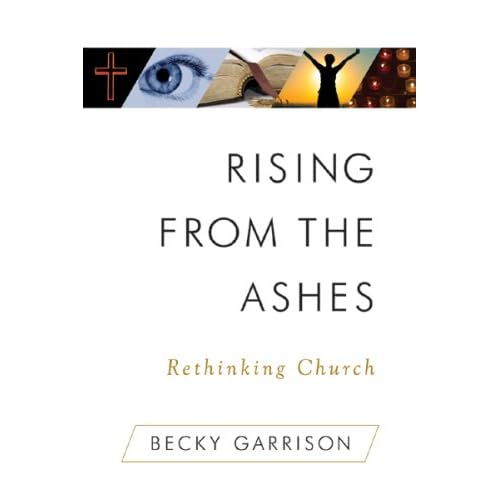
I just finished reading Becky Garrison's newest book 'Rising from the Ashes' and liked it so much I thought I would try to wet your appetite. This is the newest book in an emerging genre I call 'emerging church...wtf,' where the author has examined a host of emerging communities or people so that they can then offer a synthetic assessment of the movement. I have a number of those such books and I will be honest and say they can't keep my attention, so I put them down to read somePannenberg or Baudrillard . After reading Garrison's book I figured out that while a nice analysis where you can pick up a book and see an organized list of characteristics found in emerging churches is pleasant, it feels synthetic and not so emerging of an approach. The traditional book in the 'emerging church...wtf' genre ends up eliminating the particularities, the disagreements, the personalities, and relationships that make the movement refreshing, at least to me. Garrison may havetranscended the category because her book preserves the oddities of the divergent emerging voices she interviewed for the book. How did she do that you may ask? Good question, the book is a collection of interviews conducted through a variety of media (phone, AIM, blog, and in person) that are then organized around the themes of the ten chapters. There are interviews with big names like Diana Butler Bass, Tony Jones, NT Wright, and Phyllis Tickle but when you get done you won't remember much of what they said. The stars of the book are the host of people who are lesser known emerging practitioners and thinkers, who when placed beside the big names demonstrate just how much good stuff is missed by most books in the genre. A few things you will notice if you are smart enough to buy and read will be a high concentration of Episcopal voices, many of which sustain my favoriteconversation throughout the book - what do we do with the Book of Common Prayer. I am not Episcopal, Baptist in fact, but this discussion shows the diversity the emerging conversation can have on one issue and after taking it in you will not say this is what an emergent type would do with the Book of Common Prayer. You will also hear arguments over the role and proper function of technology, ritual, tradition, and innovation. You will read a book that is packed full of theology but not more than threesentences of theology that isn't practical and nothing practical in the book isn't treated as theology. The real reason you should get this book is because it has so many great quotes to steal or appropriate. When you read it you will be grateful that Garrison was a good member of the emerging movement and knew that the best way to get to the point is to keep asking good questions. Here are some zinger-of-a-quotes I found.
"Christianity at its core doesn't explain life, but it brings life."
"Like it or not, liberation has to happen for the oppressor, who is acting out of a place of fear and not liberation."
"We are political but not partisan. We're value driven but not ideological. We are civil but not soft. And we are involved, but we are not used or co-opted by other forces, be they government or commercial."
"Ritual is embodied participatory action."
"Ritual is what people consciously and deliberately choose to do again."
"The liturgy is our work, the work of the people. Now you get to listen closely to where God is calling us, and to bring that wisdom and insight to light in the worship that we all share."
"If you start with pure reason, you'll never get your heart fully enough involved to get down and change things."
"Anglican churches - need to become wombs of the divine - centered on transformative community centered on love and justice."
****My Favorite Question and Answer I couldn't edit****
Which population do you feel are especially drawn to these ancient spiritual practices, and why?
"Younger-than-Baby-Boomer folks: members of my own generation are stilled mired often in 'rebelling against the Establishment' and deconstructing beyond meaning every traditional image or resource. What Boomers don't get is that such zeal is not a universal - it is culturally conditioned and has hit itsexpiration date. Younger folk don't have any interest in gathering and hearing why they no longer have to believe the story-as-it-was-told-when-they-were-little. There is no more 'establishment' as envisioned by the 'Me-Generation.' All there is left is an economy, and a crushing array of people and forces willing and eager to sell everything to blocks of people identified as a 'demographic.' Churches of all ilk fall into this same anxious, predatory pattern of selling, and many denominations haveunapologetically adopted wholesale marketing techniques and called it 'evangelism.' Younger folk do not want Jesus sold to them as a commodity. they want a faith that is free and authentic and are open to manifestations of that faith that have stood the test of time and might throw a little light on an alienated and market-driven age."
Well all those quotes are from people who are not big names and those snippets are part of much larger and beautiful conversations. Go read it and enjoy. Thanks Becky for putting this together.
Monday, November 5, 2007
Atheism on the comeback
Brian McLaren has finally demonstrated that he is in fact an atheist. It is pretty clear from this video that he doesn't think the God revealed in Christ is an American Empire building War-monger. He may have even sneakedly suggested other dubious things that I dare not mention, but I am sure you will hear them if you have ears to hear.
Thanks Brian. Been thinking the same thing for a while.
Thanks Brian. Been thinking the same thing for a while.
Tuesday, October 2, 2007
Tony Jones Agrees, John MacArthur is a Gnostic
Tony Jones has made my day. In a sermon last Sunday, which you can hear here, he not only responded to the Yoga bit on CNN I posted a while ago but called MacArthur out as a modern day Gnostic. I have thought this since May when I went to a luncheon with him here in Winston, but never posted something about it. I will think of how to tell the story while you listen to Tony. Emerge on Tony.
UPDATE: Tony has a sweet new blog post that pertains which i enjoyed.
UPDATE: Tony has a sweet new blog post that pertains which i enjoyed.
The Serpent, Conversation, and the Truth War
A friend from SEBTS asked me how I would respond to the theological challenges Driscoll brought up in his lecture at the Convergent Conference. I told him that if you assume as much as foundational to the Christian Faith as Driscoll does it is hard to respond other than to say, 'you don't speak for all Christians, but you do a great job as a cool beer drinking fundamentalist from the Reformed tradition.' So my goal here is just to point out how one might have a different framework for thinking that can lead to Driscoll-judged 'heretical conclusions' while being a committed Christian and attentive reader of scripture. I had list of different possible entry points but it is hard to pass up on Driscoll borrowing ammo from John MacArthur about the 'danger' of the emergent 'conversation.'
I saw both Driscoll and MacArthur attack the viability of the emergent conversation because it was a dreaded 'conversation' that lead to the fall. Basically they look at the story of Eve and the Serpent (not Satan in Genesis) where she ends up eating the fruit in disobedience to God and sharing it with Adam which results in a bunch of fractured relationships between Eve, Adam, and God. On the surface this looks like a good reason to avoid theological conversation, especially if the theological dialogers are either a women or a reptile, because in this text a conversation leads to the disobedience that has been cursing us ever sense. After making these observations the assumption, at least how I understood it, was that the emergent conversation is similar to the conversation of Eve and the Serpent and should therefore be avoided by all sanctified people. MacArthur went as far to say, (and I am quoting from my napkin when I attended a luncheon with him) "you need to realize we are in a war, the truth war, and it began not with an invasion of an army but with a conversation." The point both Driscoll and MacArthur want to make is having a conversation is a threat, not a fertile ground for truth. If they are right then the emergent conversation is a really big mistake and we should just get our bibles and John Calvin commentaries out and work them until Jesus comes back. I think this idea (not the people) is not only stupid and impractical but actually an impoverished reading of the Genesis text. I think the story of the relational breakdown in Genesis 3 would have benefited from more conversation and not less. In fact, if this story is telling us how we got to be in the situation we are in, namely in a matrix of fractured relationships (God, Self, Others, Creation), then the opposite is true and truth needs conversation.
I don't want to talk forever, so I am going to just point out some conversations that should have happened and then you go read your bible and see if you think I could be on to something.
#1: Adam should have been honest and told Eve the truth about God's command. In Gen. 2:16-17 says to Adam pre-Eve "‘You may freely eat of every tree of the garden; but of the tree of the knowledge of good and evil you shall not eat, for in the day that you eat of it you shall die." Then when Eve answers the Serpent's question about God's command she says in Gen 3:3 "You shall not eat of the fruit of the tree that is in the middle of the garden, nor shall you touch it, or you shall die.” So what is different in how God gave the command to Adam and how Eve presumably heard it from Adam?
- First, she doesn't know what the tree is but only where it is. The command of God given for a good redemptive purpose is turned into command without a reason though Adam kept the divine threat.
- Second, Eve's rendition includes a command not to touch the fruit. Why would God's command have changed? Did the fruit grow cooties or did Adam punk out from having a real conversation with his partner and instead just built a legalistic shelter around a command of God to avoid having to explain its life giving purpose and God's good intention for the command. Instead of having a real and honest conversation about truth, meaning, God, values, and the world they lived in Adam apparently said, "Don't eat, Don't Touch, or Die."
- Lastly an observation. How did Eve get suckered in by such a stupid question, "Did God say, “You shall not eat from any tree in the garden?" Other than the question was on a topic Adam should have been conversing with her about it doesn't make sense why you would take this question seriously. I imagine Eve, the Bible's first theologian, was looking for a place to have a conversation and wasn't finding it with her partner so she entered into a conversation with the no good crafty serpent at the first sign of open space to actually converse about truth. If Adam had started an emergent cohort or simply told his own faith experience instead of building legalistic ethical bunkers then Eve would have said, "You sneaky serpent we only avoid eating from one tree, for this reason, it serves this purpose, and is a way I honor and connect to my loving God."
#2: Adam should have entered the truth war by conversing with Eve while the serpent was present. In the text you have Eve decide she wants knowledge (something Adam didn't do much talking with her about) and so she first touches the fruit and then eats it. If Adam had said when she touched it, "Eve we need to talk, I didn't tell you the truth about the fruit. We can touch it just not eat it and here is why....insert conversation.....gaining of knowledge.....because God loves and desires the best for us....will you forgive me for not being honest and eliminating conversation about truth in our relationship" then maybe things would have gone differently. Instead Eve disobeys Adam's made up rule and God's without knowing the truth of the situation, all in her search for knowledge. This could have been avoided by a real theological conversation with Adam. See Adam was the one 'in the know' and his desire to avoid a conversation set up the conditions for disobedience. The point here is that while Eve disobeyed the command first, truth was absent because of a lack of conversation not because of conversation.
Well read the bible and let me know what you think.
There is a more detailed discussion about the Genesis 3 text over at The Flaming Heretic? (a super sweet moravian theo-blogger)
I saw both Driscoll and MacArthur attack the viability of the emergent conversation because it was a dreaded 'conversation' that lead to the fall. Basically they look at the story of Eve and the Serpent (not Satan in Genesis) where she ends up eating the fruit in disobedience to God and sharing it with Adam which results in a bunch of fractured relationships between Eve, Adam, and God. On the surface this looks like a good reason to avoid theological conversation, especially if the theological dialogers are either a women or a reptile, because in this text a conversation leads to the disobedience that has been cursing us ever sense. After making these observations the assumption, at least how I understood it, was that the emergent conversation is similar to the conversation of Eve and the Serpent and should therefore be avoided by all sanctified people. MacArthur went as far to say, (and I am quoting from my napkin when I attended a luncheon with him) "you need to realize we are in a war, the truth war, and it began not with an invasion of an army but with a conversation." The point both Driscoll and MacArthur want to make is having a conversation is a threat, not a fertile ground for truth. If they are right then the emergent conversation is a really big mistake and we should just get our bibles and John Calvin commentaries out and work them until Jesus comes back. I think this idea (not the people) is not only stupid and impractical but actually an impoverished reading of the Genesis text. I think the story of the relational breakdown in Genesis 3 would have benefited from more conversation and not less. In fact, if this story is telling us how we got to be in the situation we are in, namely in a matrix of fractured relationships (God, Self, Others, Creation), then the opposite is true and truth needs conversation.
I don't want to talk forever, so I am going to just point out some conversations that should have happened and then you go read your bible and see if you think I could be on to something.
#1: Adam should have been honest and told Eve the truth about God's command. In Gen. 2:16-17 says to Adam pre-Eve "‘You may freely eat of every tree of the garden; but of the tree of the knowledge of good and evil you shall not eat, for in the day that you eat of it you shall die." Then when Eve answers the Serpent's question about God's command she says in Gen 3:3 "You shall not eat of the fruit of the tree that is in the middle of the garden, nor shall you touch it, or you shall die.” So what is different in how God gave the command to Adam and how Eve presumably heard it from Adam?
- First, she doesn't know what the tree is but only where it is. The command of God given for a good redemptive purpose is turned into command without a reason though Adam kept the divine threat.
- Second, Eve's rendition includes a command not to touch the fruit. Why would God's command have changed? Did the fruit grow cooties or did Adam punk out from having a real conversation with his partner and instead just built a legalistic shelter around a command of God to avoid having to explain its life giving purpose and God's good intention for the command. Instead of having a real and honest conversation about truth, meaning, God, values, and the world they lived in Adam apparently said, "Don't eat, Don't Touch, or Die."
- Lastly an observation. How did Eve get suckered in by such a stupid question, "Did God say, “You shall not eat from any tree in the garden?" Other than the question was on a topic Adam should have been conversing with her about it doesn't make sense why you would take this question seriously. I imagine Eve, the Bible's first theologian, was looking for a place to have a conversation and wasn't finding it with her partner so she entered into a conversation with the no good crafty serpent at the first sign of open space to actually converse about truth. If Adam had started an emergent cohort or simply told his own faith experience instead of building legalistic ethical bunkers then Eve would have said, "You sneaky serpent we only avoid eating from one tree, for this reason, it serves this purpose, and is a way I honor and connect to my loving God."
#2: Adam should have entered the truth war by conversing with Eve while the serpent was present. In the text you have Eve decide she wants knowledge (something Adam didn't do much talking with her about) and so she first touches the fruit and then eats it. If Adam had said when she touched it, "Eve we need to talk, I didn't tell you the truth about the fruit. We can touch it just not eat it and here is why....insert conversation.....gaining of knowledge.....because God loves and desires the best for us....will you forgive me for not being honest and eliminating conversation about truth in our relationship" then maybe things would have gone differently. Instead Eve disobeys Adam's made up rule and God's without knowing the truth of the situation, all in her search for knowledge. This could have been avoided by a real theological conversation with Adam. See Adam was the one 'in the know' and his desire to avoid a conversation set up the conditions for disobedience. The point here is that while Eve disobeyed the command first, truth was absent because of a lack of conversation not because of conversation.
Well read the bible and let me know what you think.
There is a more detailed discussion about the Genesis 3 text over at The Flaming Heretic? (a super sweet moravian theo-blogger)
Monday, October 1, 2007
The Driscoll Train and The Invite Person or Dude
Steve Knight posted a giant summary of the responses to Driscoll rolling around the internet. Also a little FYI, The Baptist State Convention of North Carolina has canceled their invite of Doug Pagitt to an event later this month. Outside of not being surprised, thinking they are still going the way of the buffalo, and desiring to avoid using bad language I want to say something to whomever initially invited Doug. I am glad you are still in the NCBSC. I am also glad you thought about trying to get new voices in. I am sorry your attempt failed because Driscoll called out your invite of his heretic friend, who is probably out a couple thousand for the canceled speaking engagement, during his guest lecture at SEBTS. I am glad that you are there invite dude. If you are down right now remember the 'p' of tulip and keep on chooglin. (p=perseverance of the saints)
UPDATE: here is a great post by Tony Cartledge that explains what happens. also, steve knight was right the invite person was apparently Chad Hall and he is no longer a NCBSC employee......
UPDATE: here is a great post by Tony Cartledge that explains what happens. also, steve knight was right the invite person was apparently Chad Hall and he is no longer a NCBSC employee......
Tuesday, September 25, 2007
Driscoll, Acts 29, and the Demerging Church
Some of you know that I have been working with an association of Baptist churches with a focus on helping their church planting team. This job made it possible for me to attend the Acts 29 church planter's bootcamp last week in Raleigh and to experience the latest edition of Mark Driscoll's attempt at being the personal paraclete for the emerging church movement. I went knowing that I wouldn't fit in with the theological agenda of Acts 29, but I guess I assumed that there would be enough room for me to breathe and learn about how they have effectively networked to plant churches. I say this because despite my rather harsh assessment of the event, I have no problem with people starting all kinds of faith communities that connect people to God even if they have a different theological imagination.
The host church, Vintage 21, in my hometown of Raleigh, is a place friends of mine worship and serve in, so I am thankful they exist. Acts 29 is an organized and effective machine, run by a group of Dudes who are passionate about their faith and network. With that said, I would like to just say that what I experienced was far from anything emerging. I have been to a bunch of minister's conferences with Emergent leaders, those friends of Driscoll who he was slandering the next day at the Convergent conference () and who have been part of the 'conversation' for a while.http://www.blogger.com/img/gl.link.gif
At the bootcamp we had 6 sessions of monologues that amounted to theological diatribes in which the only viable theological stance was surprisingly theirs, a compassionate conservative Reformed theology. (OK, Chan Kilgore didn't diatribe and this doesn't apply to him. In fact he was the only one I was thankful to have heard.) So in this two days of Reformed 2.0 rhetoric what did I learn?
* That to be "gospel-centered" you have to hold to a list of theological conclusions that were not all developed and connected until the 17th century.
* That what the postmodern world needs is more white Dudes preaching hour-long exegetical sermons in which all texts mean Christ and Christ means Acts 29 Reformed 2.0 Christianity.
* That no pastor's wife should have a job or desire "household duties to be divided equally between the man and woman"
* That you can insist all elders be "not violent" while at the same time saying that, should a church planter deviate from the Reformed 2.0 agenda in an egalitarian way (e.g., "getting pushed around by a feminist"), Mark Driscoll will personally fly out to your church and "kick you in the throat."
* That a bootcamp of called church planters need not include dialog until after the full 8 hours of Reformed 2.0 downloading is done (and then discussion is moderated, filtered, and nothing more than a pony show for Driscoll to say more entertainingly outlandish things).
I have a big list of things I noticed, but what bothered me most is that the Acts 29 response to our new postmodern situation is to grip a thoroughly modern Reformed theology in the Dude's right hand really tight and then think he is better than a fundamentalist because he has a beer in his left hand. This isn't emergent, it is demergent. This is the disgruntled indie rocker's version of the Reformation.
There is much to learn and keep from the Reformation, a movement that was thoroughly modern, but there is reason to give pause to returning to it with a clinched fist. Right now I think the last thing the Church needs are white dudes with clinched fists, especially when what they are clenching is "God's Truth." Throughout modernity white Dudes have had God's truth in their hands too much, and behind them are ditches filled with God's and\or their enemies. (This confusion is easy when you have truthtightly gripped in a fist)
The emergent "conversation" Driscoll is so scared of, and the questions that many of us at the bootcamp had in our minds and couldn't ask, are important. It may be my depravity talking, but I imagine God not scared of conversation, I imagine that truth is not dependent on myself, Doug Pagitt, Karen Ward, or Mark Driscoll, and I am confident that, as the Church finds its bearing in a new world, we don't need any more clinched fists, for it is God's world and God's truth after all.
The host church, Vintage 21, in my hometown of Raleigh, is a place friends of mine worship and serve in, so I am thankful they exist. Acts 29 is an organized and effective machine, run by a group of Dudes who are passionate about their faith and network. With that said, I would like to just say that what I experienced was far from anything emerging. I have been to a bunch of minister's conferences with Emergent leaders, those friends of Driscoll who he was slandering the next day at the Convergent conference () and who have been part of the 'conversation' for a while.http://www.blogger.com/img/gl.link.gif
At the bootcamp we had 6 sessions of monologues that amounted to theological diatribes in which the only viable theological stance was surprisingly theirs, a compassionate conservative Reformed theology. (OK, Chan Kilgore didn't diatribe and this doesn't apply to him. In fact he was the only one I was thankful to have heard.) So in this two days of Reformed 2.0 rhetoric what did I learn?
* That to be "gospel-centered" you have to hold to a list of theological conclusions that were not all developed and connected until the 17th century.
* That what the postmodern world needs is more white Dudes preaching hour-long exegetical sermons in which all texts mean Christ and Christ means Acts 29 Reformed 2.0 Christianity.
* That no pastor's wife should have a job or desire "household duties to be divided equally between the man and woman"
* That you can insist all elders be "not violent" while at the same time saying that, should a church planter deviate from the Reformed 2.0 agenda in an egalitarian way (e.g., "getting pushed around by a feminist"), Mark Driscoll will personally fly out to your church and "kick you in the throat."
* That a bootcamp of called church planters need not include dialog until after the full 8 hours of Reformed 2.0 downloading is done (and then discussion is moderated, filtered, and nothing more than a pony show for Driscoll to say more entertainingly outlandish things).
I have a big list of things I noticed, but what bothered me most is that the Acts 29 response to our new postmodern situation is to grip a thoroughly modern Reformed theology in the Dude's right hand really tight and then think he is better than a fundamentalist because he has a beer in his left hand. This isn't emergent, it is demergent. This is the disgruntled indie rocker's version of the Reformation.
There is much to learn and keep from the Reformation, a movement that was thoroughly modern, but there is reason to give pause to returning to it with a clinched fist. Right now I think the last thing the Church needs are white dudes with clinched fists, especially when what they are clenching is "God's Truth." Throughout modernity white Dudes have had God's truth in their hands too much, and behind them are ditches filled with God's and\or their enemies. (This confusion is easy when you have truthtightly gripped in a fist)
The emergent "conversation" Driscoll is so scared of, and the questions that many of us at the bootcamp had in our minds and couldn't ask, are important. It may be my depravity talking, but I imagine God not scared of conversation, I imagine that truth is not dependent on myself, Doug Pagitt, Karen Ward, or Mark Driscoll, and I am confident that, as the Church finds its bearing in a new world, we don't need any more clinched fists, for it is God's world and God's truth after all.
Thursday, September 13, 2007
The Truth War On Yoga
Oh my, this is just unbelievable. Not only is this discussion ridiculous but the fact CNN covered it on 9-11 is even more troublesome. I think john macarthur is crazy and he normally proves it when I listen to his radio show, but this may be a whole new level of detachment from reality. If either Doug or John is suppose to be a gnostic, a heretical label John labels Doug and his emergent friends with, then why is the gnostic the one advocating an embodied wholeness and why is the gnostic the only one who appears sane?
Sunday, July 29, 2007
McLaren on Justice, Power, and the Kingdom
I mentioned this video to a friend and said I would post it here. Enjoy, it isn't that hard. Peace.
Friday, June 29, 2007
Two Sweet Free Articles


SO today I cam across to free theology articles that I support you reading.
1. Tony Jones was rejected by Wheaton who decided not to publish his plenary lecture at their theology conference this year. So, go read it and realize just how to combine baseball, the early church fathers, and emerging churches together.
2. Marjorie Suchocki, the most kind theologian I have ever met, has her introduction to Process Theology lecture at the Process and Faith website for free. If you ever had any interest in Process Theology, then check it out.
Monday, June 18, 2007
Emerging Community Vision pt.2

Part One, Christocentric Community is here.
Sacramental Living: The cultural landscape of modernity created a rigid and attentively maintained distinction between sacred and secular space. In a postmodern context this divide is no longer life giving and so the emerging community will seek to sacramentalize spaces, places, faces, and name traces of God’s creative goodness in the world. This process of sacramentalizing life includes worship but extends to the life of each member in their daily living. The goal is that the life of the community be one that is attentive to the presence of God, that celebrates the goodness of God’s world, and creates space for the grace of God to permeate its life together.
1. Worship: The worship services will be geared toward a holistic expression of the Gospel. In modernity the written\spoken media dominated the life of the worship service so that the Word of God was equated to the reading of scripture and its exposition in a sermon. While these both have their place in worship the community will also seek to express God’s story through the diversity of media available (including the arts), seek to engage more senses through interactive – participatory elements of worship, and intentionally shape worship to the liturgical calendar so the church’s story grounds the life of the community. [ex. The sermon would not be the centerpiece of the worship service and would more than likely not be a monologue of imparting knowledge, but more dialogical and engaging. OR Baptist theology of baptism and an Anglican view of Communion.]
2. Community: The relationships in the community will be valued at a premium. The relationships between the members, guests, the community, the marginalized, and God are all part of the universally expanded network of Godbelovedness our Abba has called us to live in love with. The first commitment of a member is a commitment to these relationships and their flourishing. The community and its living should be an open space of grace that gives the welcome of Christ to all, inviting all it encounters to a transformative relationship with God, and being there to encourage and help each other along the journey. [ex. When someone joins the community the community will change because they are a part of it. The community promises to become a place where we can flourish together and so everyone is asked to share something that is part of their giftedness and uplifting to the community.]
3. Vocation: Part of taking down the sacred-secular divide is demolishing the ordained – laity divide. The Emerging Community would not only seek to incorporate its members into the life of the church and its service to the world, but also help develop an understanding of vocation where each member sees their own occupation as part of the church’s ministry and service to God. The community would be a community of ministers who serve in a variety of occupations in the city they are called to serve. [ex. If there is a teacher in the community, they are known as a minister of education and child of God development. If there is a lawyer, they are known as a minister of legal services for the coming of God’s kingdom.]
Sunday, June 17, 2007
Who's Afraid of Post-Modernism?


James K. A. Smith gives an interesting introduction to postmodernity that could work for those with little or no theology\philosophy background. Each chapter focuses on a film that he uses to draw out the meaning behind bumper sticker phrases by the most noted of the deconstructionist philosophers. For a general setup of pomo in chapter one he uses ‘the Matrix.’ Chapter two is a discussion of Derrida, the superb film ‘Memento,’ and Derrida’s infamous line ‘there is nothing outside the text.’ Chapter three looks at Lyotard, ‘O Brother Where Art Thou?’ and those evil ‘metanarratives’ modernity gave us. Chapter four
Soul Graffiti


Emergent folks often talk about following Jesus or living in the way of Jesus, but rarely is this phrase followed by story after story of a life in process of Christo-transformation. If you want to hear some of these stories and be challenged by them then go get Mark Scandrette’s new book ‘Soul Graffiti.’ The book is organized into four parts that follow the initial teaching of Jesus in gospel of Mark and the though Scandrette does occasionally give direct theological reflection, the book itself is story driven and oh so compelling. When you get done you will either be fired up that someone in the First World is actually identifiably Christian, which gives you hope for yourself or be irritated that you read a book that ended up challenging you to the core. Or both. Scandrette is a luring story-teller which enables his family and community in San Fran to untame Jesus and the gospel for the reader. He mentions taking the risk of being offended by Jesus and his teachings and his stories reveal to us just how offended we need to get, but also how rewarding a life on the way of Jesus can be. If you want to be encouraged, challenged, and have a stack of super sweet stories to bring up next time some one asks what following Jesus looks like the get it, read it, and do it.
Sunday, June 3, 2007
EMERGING COMMUNITY VISION pt.1
This summer I am interning with the local baptist association and their church plants. One of my jobs is writing up a brief description of a potential emerging community that could be used to help explain it to church people who may not know anything about the emergent movement so that they have some idea what they are supporting. I came up with a couple points and here is the first. If you have any ideas for being more clear feel free to share. Yes, I do know it is not really possible to describe an emerging community when it doesn't exist. I am just trying to get some kind of community vision guide together to hopefully firm up support. Enjoy.
Christocentric Community: The story of Jesus’ life, ministry, cross, resurrection, and active presence through the Spirit is the center piece of the community. As it develops it will begin with the story of Jesus, because in Christ we come to know who God is, God’s desire for creation, and the world’s future in God. First and foremost the community is living in the way of Jesus. Three parts of the ministry of Jesus will serve as guideposts to Christocentric life in the community: mysticism, mission, and message.
1. Mysticism. The story of Jesus reveals a world that God has created and in which God is actively present and working. Jesus lived and practiced the presence of God, whom he knew intimately as Abba, and this experience transformed his message and empowered his mission. An emerging community would be intentional on creating space for the Spirit of God to come in surprising and intimate ways. In a culture that is spiritual but not religious the followers of Jesus should actively proclaim and practice the Abba-intimate mysticism of Jesus.
2. Mission. For an emerging community there is an identification of the mission of Jesus with the mission of God. Jesus proclaimed and brought the presence of the kingdom of God. He also empowered and sent his disciples to do same. For this reason the kingdom of God is the most important theological concept for understanding the work of church. This community will intentionally focus itself on the mission of God and seek to participate. Doing so means that the community will be externally focused, people driven, and seek healing and reconciliation.
3. Message. Jesus is not just the one who made God present in a dynamic and mystical way, nor is he just the one who proclaimed the mission of God for the world, but Jesus himself was the message. His message was not simply preached but embodied. Jesus, the Word of God, is more than words and so the emerging community will witness to the message of God through embodiment. Every media and every relationship can become a spirit-filled medium for revelation and transformation of God. Recognizing this means the message of the community is more than words and doctrine but an invitation to experience the presence of God and embody the way of Jesus.
Tuesday, April 3, 2007
Emerging Fear and the SBC
How do you draw more attention to the emerging movement? Like This. If you say blanket statements like the emerging church is "one of the most dangerous and deceptive movements to infiltrate the ranks of Southern Baptist life," you could think that might be an overstatement of fearful dread over the unknown, but I think not. The SBC should fear the emerging movement, because emergent types do two things that can ruin the SBC. 1-Talk 2-Think And they do these at the same time. What happens when these two powerful forces join hands, thinking and talking, you realize you don't need to continue to be subject to the fear mongering of modernity in its worst form. Hell is the religious fear-bearing motivation and Islamo-fascism is the political form. (Well there are more like French atheists, homosexuals and liberals.) So I agree with Roger Moran, the SBC should fear the Emerging movement. Moran is not moron, just observant. Well I would say those baptists who were exiled from the convention with emerging leanings don't want the bureaucracy back. Keep all you stole or won. I think the baptist Fall or Ascension in 79 may have been the best thing that could have happened for real baptists (other than the bitterness part). Power corrupts and convention power corrupts the gospel into conventional fluff.
Bill Leonard makes a good observation, "The Southern Baptist Convention is growing increasingly terrified that they've spent all this time recreating the denomination in this (conservative) image, and now nobody cares," he said. "Young seminarians are challenging them on issues and saying, 'Your vision of reality is not ours.'" OH how I hope this is true.
[an aside] I know the SBC is the Southern Baptist Convention, but I decided sometime in high school always to use SBC instead. I think it parallels Kentucky Fried Chicken’s switch to KFC because they had genetically altered their chicken so much they couldn’t keep it in the name. I bet the KFC story is an urban legend, but I think it works well with the SBC.
Bill Leonard makes a good observation, "The Southern Baptist Convention is growing increasingly terrified that they've spent all this time recreating the denomination in this (conservative) image, and now nobody cares," he said. "Young seminarians are challenging them on issues and saying, 'Your vision of reality is not ours.'" OH how I hope this is true.
[an aside] I know the SBC is the Southern Baptist Convention, but I decided sometime in high school always to use SBC instead. I think it parallels Kentucky Fried Chicken’s switch to KFC because they had genetically altered their chicken so much they couldn’t keep it in the name. I bet the KFC story is an urban legend, but I think it works well with the SBC.
Friday, March 23, 2007
Friendship as Missional Foundationalism Pt 3
'Zacchaeus stopped there and said to the Lord, ‘Look, half of my possessions, Lord, I will give to the poor; and if I have defrauded anyone of anything, I will pay back four times as much.’ Then Jesus said to him, ‘Today salvation has come to this house, because he too is a son of Abraham. For the Son of Man came to seek out and to save the lost.’
Luke 19:8-10
salvation\the movement of God in the context of friendship
Zacchaeus responded quickly to Jesus’ proclamation of belonging and despite the protest of the holy grumble Jesus came as a guest and friend to the table of Zacchaeus. There is some space here in the story. We do not know what the decision of the grumblers was. Did they stay outside in the holy huddle even though Jesus would be leaving them behind, did they stomach becoming a guest of Zacchaeus’ too, or maybe they even realized what was going on and stayed in the company of Jesus by participating in the friendship of the God Movement. While we do not know what happened with that particular crowd, it would not be far fetched to imagine their response was as varied as our own today. Yet these verses are no longer focusing on the conflict between the crowd’s vision of Zacchaeus and that of Jesus’, but instead the transformation of Zacchaeus as a new friend of God.
The text emphasizes the radical and quick response of Zacchaeus to his new found circle of friends. The divine initiative and proclamation of belonging shakes Zacchaeus to his core. Before they even make it to his home he stops and voluntarily offers half of his possessions to the poor and promises to make four-fold restitution to all he defrauded. Surely this was good news for those grumbling minutes before. Those to whom Jesus most identified with and called blessed - the poor, hungry, and weeping - were frustrated by Jesus’ movement towards the exemplar sinner and recipient of prophetic woes – the rich, full, and happy. What occasioned this radical transformation is the embrace of God through the person of Jesus. Zacchaeus as rich, tax-collecting, poor exploiting, empire supporting, sinner was embraced into the friendship of God. In response to his new friendship and not prior to it, Zacchaeus repents in the fullest measure. The teachings of Jesus never fare well for the rich and Zacchaeus and Levi are the only ones who respond favorably. Why would friendship with God be so difficult that it would be easier for a camel to go through the eye of a needle than one who is rich to enter the kingdom of God? This is not only a perplexing question, but one the affluent church of the first world should attentively listen to. The response of Zacchaeus is revealing, because moments after entering the friendship of Jesus he entered into friendship with the people of Jesus. The overwhelming majority of Jesus’ people were the poor, oppressed, and marginalized. Jesus’ preferential option for the poor creates a dilemma for the rich and this dilemma is one of friendship and not obligation. Obligation is not a category of friendship, because friends are attentive to the situation of each other and respond out of love for the other. When Zacchaeus entered the belonging friendship of God he was now attentive to the situation of his new friends. They were no longer people to be exploited and bled for his own gain, but people he was now going to live with in the presence of Jesus. The repentance of Zacchaeus was not first to God, but the people of God – the friends of God. In the context of these relationships the sin of Zacchaeus is revealed as social and not simply private and individual. The salvation Jesus identified and proclaimed was then as social as the sin. The gospel is social, more social than sin because in the consummation of the God Movement creation will find its intended identity in the friendship of God.
The condemnation of the injustice practiced by Zacchaeus comes when his oppressed Other is no longer dehumanized. In the presence of Jesus they too are given names, identities, and the God given value of life is made known. The dichotomy of oppressed and oppressor is over come in the bounds of friendship in God. The evangelization of the power wielders is a liberating one, but not in a detached way. Friendship as the foundational context of the gospel helps Zacchaeus and his contemporaries in every age realize that “only by participating in [the marginalized] struggles can we understand the implications of the gospel message and make it have an impact” in our relationships with them. Those who enter into the friendship of God “do with their own resources what God has been doing with God’s, that is, [empowering] those who are powerless.” It is important then to notice, as members of the contemporary church of Zacchaeus, the nature of his response which is two fold. His first response is to shed his abundance. In light of his new friends struggling to have their own necessities met Zacchaeus rids himself of his gluttony of mammon and simply gives half of his possessions to the poor. The realization in the context of friendship is that much of his impressive pile of stuff was in fact not his own. In response he gives half of his possessions to the dispossessed around him because he was no longer going to be possessed by his possessions or continue to perpetuate the lie that he in fact had the right to wealth while his friends struggled for necessities. What this first act is not is charity. This act was not detached from his inclusion into the friendship of Jesus and Jesus’ ensuing pronouncement of salvation. It is only in the context of friendship and repentance that the God movement “becomes Good News for Zacchaeus and salvation enters his house.” When one on the take from Rome became friends with Jesus, when he experienced the presence of the God Movement in real relationship, he recognized his sin and did more than give charity. He repented for having extorted what was not properly his. When the wealthy and powerful enter the God Movement they see a friend in need as a call to confession for having taken more than their share and justified their thievery by adopting the dehumanizing world view of Empire – here Rome. The lesson learned is simple, “the ultimate evil of riches is relational: the oppression of the poor.”
The second voluntary act of Zacchaeus is even more telling if our comfort and imperial hermeneutic led us to interpret the first as simple charity. Here Zacchaeus promises to make a fourfold restitution if he has cheated anyone. The ’if’ here is conditional only in the sense that specific acts of extortion will come to light as he lives in relationship to his new friends. What he is committing himself to is the most stringent demands given in Torah for stealing. The conditional form of his statement is connected to having never seriously thought of life otherwise. In the past, like many of us privileged people, he did not think twice from reaping the benefits of a system that culturally marginalizes, economically exploits, and politically oppresses a majority of the human population. Since it was his job and he broke no laws he was not stealing, but playing fair by the rules making all his wealth his own earnings. After entering the friendship of God this previous determinative reality is revealed as an idolatrous interpretive reality whose God is mammon. The rich are those left to chose who they will serve, for you cannot serve both God and mammon. When Zacchaeus says ‘if’ he is in effect admitting he does not know what it would look like to give himself to the God Movement and live in the loving mutuality of friendship with those who now have a name. At first glance he knows it requires a shedding of wealth, but immediately after that realizes that as he comes to be shaped more fully by his new relationships he may, and more than likely will, realize he has extorted someone. If he discovers this while living his life with the marginalized he will repay them fourfold. Zacchaeus has publicly committed himself to the God Movement and is in the process of being shaped by its vision or better yet, he is being converted. Today in the 21st century the affluent first world church also needs friendships that bring relational accountability “to those who are forced to provide us with “the good life” at their expense,” because abstract ethics are not only contrary to the nature of friendship, but easily manipulated. Manipulation is contrary to true friendship, for in friendship there is an unforsakable solidarity funded by the love of God. The ‘if’ of Zacchaeus is a commitment not to defend his privilege, he will not blunt the gospel to a spiritual language with no consequence in the world he and his friends live in. The repentance and new found stance of Zacchaeus “leads to a redistributive form of justice in which those defrauded by an exploitive system are repaid fourfold…The restoration of kinship status involves repentance, and repentance involves redistributing what has been taken falsely.” Zacchaeus took on a new interpretive frame work, the God Movement. In the framework of human empire, “the rich are all the people who live with tightly clenched hands. They are neither dependant on others nor open for others. The rich can only be helped when they recognize their own poverty and enter into fellowship with the poor.” Zacchaeus made this transition and joined the Movement. At this point, and not earlier, does Jesus say “today salvation has come to this house, because he too is a son of Abraham. For the Son of Man came to seek out and to save the lost.’
What does salvation mean here? It is clearly contextual, social, and a far cry from the individualist gospel present in church today. It does not promise security or prosperity in any worldly fashion and is decidedly obtuse and backwards to the logic of success and empire. The salvation of Zacchaeus is multifaceted and cannot be limited to a question of eternal destination. When Zacchaeus joined the God movement he claimed his identity as a son of Abraham, he came to be identified by his blessing of others. Zacchaeus’ blessing of others is not in his giving of material wealth and restitution - that was part of his relational repentance - his blessing of others comes in the reorganization of his life and relationships to no longer be a slave of mammon, but a friend of God. He will bless others by living for the common good of his friends and not preserving the good life for himself.
Just before arriving to Jericho and healing the blind man Jesus was asked a question that assumed a very impoverished view of salvation, one that we will see is foreign to the gospel. A rich ruler asks ‘What must I do to inherit eternal life?’ It is no surprise that the rich ruler wants to discuss eternal destiny with economic terms of inheritance, because he envisions salvation as a possession given by God to individuals. The poor experience inheritance as the preservation of the oppressive system which ensures longevity to the gains of the wealthy. Jesus then asks him if he knows the commandments related to inter-human relationships – “you shall not commit adultery; you shall not murder; you shall not steal; you shall not bear false witness; honor your father and mother.” All these inter-human commandments the rich ruler reports to have kept since he was young, but Jesus knows that there is still one thing a miss so Jesus says, “Sell all that you own and distribute the money to the poor, and you will have treasure in heaven; then come, follow me.” Jesus was not using hyperbole to point out some spiritual struggle between his wealth and belonging to God, it was clearly physical. The commandments Jesus listed, and he did know them all, were those centered on human relationships. He then says one thing is lacking. The rich ruler thought of these categories in very individualistic terms and missed the point, just as he did when he started the conversation about eternal destiny. Sure he had not personally broke the law and stole from the poor directly, but this is not keeping the commandment of God not to steal. As we have seen in the salvation story of Zacchaeus the relational notion of theft only becomes clear to the rich when they are friends with the oppressed. In order to both answer the Rich Ruler’s question and not compromise the integrity of the God Movement, Jesus is left to offer him what he needed but could not fathom due to his love of stolen wealth. The Rich Ruler was after one thing only, confirmation of his current life style’s compatibility with an eternal inheritance. Outside of joining the friendship of God, Jesus could not give him what he wanted; a neutered gospel of confirmation that keeps the affluent happy, healthy, and heaven bound without one having to every enter into the friendship of God which will transform all who dare to enter. The Rich Ruler however does understand Jesus, since on hearing this he was sad because he was rich. We do not know what happens to this Rich Ruler, he may have responded later in life. We know the friendship of God is as near as the marginalized and the offer is always open.
In response to this direct confrontation with wealth the disciples ask just who then can be saved to which Jesus replies, “What is impossible for mortals is possible for God.” This question was more than a question of the salvation of the wealthy but of anyone. Jesus’ answer leads us back to where we started, friendship with God. Salvation is impossible for mortals, but for God it is friendship. Salvation for one and all is then joining the movement of God in friendship. This truth will surely revolutionize our theology, but more than that our mission. As the church most akin to Zacchaeus we must refuse to describe friendship as something that can be had without the inclusion of our Two-Thirds world sisters, brothers, and enemies. We must take the advice of Martin Luther King seriously who said that “we will either live together as sisters and brothers or perish together as fools.” How would our relationships change with the marginalized should be become friends and realize that they are the global majority who live in poverty and we are the affluent global minority? We must also refuse to be ministers who preach a sermon that leaves Zacchaeus in a tree and the Rich Ruler happy. If we are to be a Jesus’ church, then we will share in the mission of Jesus and preach the message of Jesus. At the foundation of the God Movement which we hope to be a part of is friendship. Friendship is the only foundationalism that can support the Good News, because friendship is the only relational structure that can begin with love for the Other in every varied form.
Luke 19:8-10
salvation\the movement of God in the context of friendship
Zacchaeus responded quickly to Jesus’ proclamation of belonging and despite the protest of the holy grumble Jesus came as a guest and friend to the table of Zacchaeus. There is some space here in the story. We do not know what the decision of the grumblers was. Did they stay outside in the holy huddle even though Jesus would be leaving them behind, did they stomach becoming a guest of Zacchaeus’ too, or maybe they even realized what was going on and stayed in the company of Jesus by participating in the friendship of the God Movement. While we do not know what happened with that particular crowd, it would not be far fetched to imagine their response was as varied as our own today. Yet these verses are no longer focusing on the conflict between the crowd’s vision of Zacchaeus and that of Jesus’, but instead the transformation of Zacchaeus as a new friend of God.
The text emphasizes the radical and quick response of Zacchaeus to his new found circle of friends. The divine initiative and proclamation of belonging shakes Zacchaeus to his core. Before they even make it to his home he stops and voluntarily offers half of his possessions to the poor and promises to make four-fold restitution to all he defrauded. Surely this was good news for those grumbling minutes before. Those to whom Jesus most identified with and called blessed - the poor, hungry, and weeping - were frustrated by Jesus’ movement towards the exemplar sinner and recipient of prophetic woes – the rich, full, and happy. What occasioned this radical transformation is the embrace of God through the person of Jesus. Zacchaeus as rich, tax-collecting, poor exploiting, empire supporting, sinner was embraced into the friendship of God. In response to his new friendship and not prior to it, Zacchaeus repents in the fullest measure. The teachings of Jesus never fare well for the rich and Zacchaeus and Levi are the only ones who respond favorably. Why would friendship with God be so difficult that it would be easier for a camel to go through the eye of a needle than one who is rich to enter the kingdom of God? This is not only a perplexing question, but one the affluent church of the first world should attentively listen to. The response of Zacchaeus is revealing, because moments after entering the friendship of Jesus he entered into friendship with the people of Jesus. The overwhelming majority of Jesus’ people were the poor, oppressed, and marginalized. Jesus’ preferential option for the poor creates a dilemma for the rich and this dilemma is one of friendship and not obligation. Obligation is not a category of friendship, because friends are attentive to the situation of each other and respond out of love for the other. When Zacchaeus entered the belonging friendship of God he was now attentive to the situation of his new friends. They were no longer people to be exploited and bled for his own gain, but people he was now going to live with in the presence of Jesus. The repentance of Zacchaeus was not first to God, but the people of God – the friends of God. In the context of these relationships the sin of Zacchaeus is revealed as social and not simply private and individual. The salvation Jesus identified and proclaimed was then as social as the sin. The gospel is social, more social than sin because in the consummation of the God Movement creation will find its intended identity in the friendship of God.
The condemnation of the injustice practiced by Zacchaeus comes when his oppressed Other is no longer dehumanized. In the presence of Jesus they too are given names, identities, and the God given value of life is made known. The dichotomy of oppressed and oppressor is over come in the bounds of friendship in God. The evangelization of the power wielders is a liberating one, but not in a detached way. Friendship as the foundational context of the gospel helps Zacchaeus and his contemporaries in every age realize that “only by participating in [the marginalized] struggles can we understand the implications of the gospel message and make it have an impact” in our relationships with them. Those who enter into the friendship of God “do with their own resources what God has been doing with God’s, that is, [empowering] those who are powerless.” It is important then to notice, as members of the contemporary church of Zacchaeus, the nature of his response which is two fold. His first response is to shed his abundance. In light of his new friends struggling to have their own necessities met Zacchaeus rids himself of his gluttony of mammon and simply gives half of his possessions to the poor. The realization in the context of friendship is that much of his impressive pile of stuff was in fact not his own. In response he gives half of his possessions to the dispossessed around him because he was no longer going to be possessed by his possessions or continue to perpetuate the lie that he in fact had the right to wealth while his friends struggled for necessities. What this first act is not is charity. This act was not detached from his inclusion into the friendship of Jesus and Jesus’ ensuing pronouncement of salvation. It is only in the context of friendship and repentance that the God movement “becomes Good News for Zacchaeus and salvation enters his house.” When one on the take from Rome became friends with Jesus, when he experienced the presence of the God Movement in real relationship, he recognized his sin and did more than give charity. He repented for having extorted what was not properly his. When the wealthy and powerful enter the God Movement they see a friend in need as a call to confession for having taken more than their share and justified their thievery by adopting the dehumanizing world view of Empire – here Rome. The lesson learned is simple, “the ultimate evil of riches is relational: the oppression of the poor.”
The second voluntary act of Zacchaeus is even more telling if our comfort and imperial hermeneutic led us to interpret the first as simple charity. Here Zacchaeus promises to make a fourfold restitution if he has cheated anyone. The ’if’ here is conditional only in the sense that specific acts of extortion will come to light as he lives in relationship to his new friends. What he is committing himself to is the most stringent demands given in Torah for stealing. The conditional form of his statement is connected to having never seriously thought of life otherwise. In the past, like many of us privileged people, he did not think twice from reaping the benefits of a system that culturally marginalizes, economically exploits, and politically oppresses a majority of the human population. Since it was his job and he broke no laws he was not stealing, but playing fair by the rules making all his wealth his own earnings. After entering the friendship of God this previous determinative reality is revealed as an idolatrous interpretive reality whose God is mammon. The rich are those left to chose who they will serve, for you cannot serve both God and mammon. When Zacchaeus says ‘if’ he is in effect admitting he does not know what it would look like to give himself to the God Movement and live in the loving mutuality of friendship with those who now have a name. At first glance he knows it requires a shedding of wealth, but immediately after that realizes that as he comes to be shaped more fully by his new relationships he may, and more than likely will, realize he has extorted someone. If he discovers this while living his life with the marginalized he will repay them fourfold. Zacchaeus has publicly committed himself to the God Movement and is in the process of being shaped by its vision or better yet, he is being converted. Today in the 21st century the affluent first world church also needs friendships that bring relational accountability “to those who are forced to provide us with “the good life” at their expense,” because abstract ethics are not only contrary to the nature of friendship, but easily manipulated. Manipulation is contrary to true friendship, for in friendship there is an unforsakable solidarity funded by the love of God. The ‘if’ of Zacchaeus is a commitment not to defend his privilege, he will not blunt the gospel to a spiritual language with no consequence in the world he and his friends live in. The repentance and new found stance of Zacchaeus “leads to a redistributive form of justice in which those defrauded by an exploitive system are repaid fourfold…The restoration of kinship status involves repentance, and repentance involves redistributing what has been taken falsely.” Zacchaeus took on a new interpretive frame work, the God Movement. In the framework of human empire, “the rich are all the people who live with tightly clenched hands. They are neither dependant on others nor open for others. The rich can only be helped when they recognize their own poverty and enter into fellowship with the poor.” Zacchaeus made this transition and joined the Movement. At this point, and not earlier, does Jesus say “today salvation has come to this house, because he too is a son of Abraham. For the Son of Man came to seek out and to save the lost.’
What does salvation mean here? It is clearly contextual, social, and a far cry from the individualist gospel present in church today. It does not promise security or prosperity in any worldly fashion and is decidedly obtuse and backwards to the logic of success and empire. The salvation of Zacchaeus is multifaceted and cannot be limited to a question of eternal destination. When Zacchaeus joined the God movement he claimed his identity as a son of Abraham, he came to be identified by his blessing of others. Zacchaeus’ blessing of others is not in his giving of material wealth and restitution - that was part of his relational repentance - his blessing of others comes in the reorganization of his life and relationships to no longer be a slave of mammon, but a friend of God. He will bless others by living for the common good of his friends and not preserving the good life for himself.
Just before arriving to Jericho and healing the blind man Jesus was asked a question that assumed a very impoverished view of salvation, one that we will see is foreign to the gospel. A rich ruler asks ‘What must I do to inherit eternal life?’ It is no surprise that the rich ruler wants to discuss eternal destiny with economic terms of inheritance, because he envisions salvation as a possession given by God to individuals. The poor experience inheritance as the preservation of the oppressive system which ensures longevity to the gains of the wealthy. Jesus then asks him if he knows the commandments related to inter-human relationships – “you shall not commit adultery; you shall not murder; you shall not steal; you shall not bear false witness; honor your father and mother.” All these inter-human commandments the rich ruler reports to have kept since he was young, but Jesus knows that there is still one thing a miss so Jesus says, “Sell all that you own and distribute the money to the poor, and you will have treasure in heaven; then come, follow me.” Jesus was not using hyperbole to point out some spiritual struggle between his wealth and belonging to God, it was clearly physical. The commandments Jesus listed, and he did know them all, were those centered on human relationships. He then says one thing is lacking. The rich ruler thought of these categories in very individualistic terms and missed the point, just as he did when he started the conversation about eternal destiny. Sure he had not personally broke the law and stole from the poor directly, but this is not keeping the commandment of God not to steal. As we have seen in the salvation story of Zacchaeus the relational notion of theft only becomes clear to the rich when they are friends with the oppressed. In order to both answer the Rich Ruler’s question and not compromise the integrity of the God Movement, Jesus is left to offer him what he needed but could not fathom due to his love of stolen wealth. The Rich Ruler was after one thing only, confirmation of his current life style’s compatibility with an eternal inheritance. Outside of joining the friendship of God, Jesus could not give him what he wanted; a neutered gospel of confirmation that keeps the affluent happy, healthy, and heaven bound without one having to every enter into the friendship of God which will transform all who dare to enter. The Rich Ruler however does understand Jesus, since on hearing this he was sad because he was rich. We do not know what happens to this Rich Ruler, he may have responded later in life. We know the friendship of God is as near as the marginalized and the offer is always open.
In response to this direct confrontation with wealth the disciples ask just who then can be saved to which Jesus replies, “What is impossible for mortals is possible for God.” This question was more than a question of the salvation of the wealthy but of anyone. Jesus’ answer leads us back to where we started, friendship with God. Salvation is impossible for mortals, but for God it is friendship. Salvation for one and all is then joining the movement of God in friendship. This truth will surely revolutionize our theology, but more than that our mission. As the church most akin to Zacchaeus we must refuse to describe friendship as something that can be had without the inclusion of our Two-Thirds world sisters, brothers, and enemies. We must take the advice of Martin Luther King seriously who said that “we will either live together as sisters and brothers or perish together as fools.” How would our relationships change with the marginalized should be become friends and realize that they are the global majority who live in poverty and we are the affluent global minority? We must also refuse to be ministers who preach a sermon that leaves Zacchaeus in a tree and the Rich Ruler happy. If we are to be a Jesus’ church, then we will share in the mission of Jesus and preach the message of Jesus. At the foundation of the God Movement which we hope to be a part of is friendship. Friendship is the only foundationalism that can support the Good News, because friendship is the only relational structure that can begin with love for the Other in every varied form.
Subscribe to:
Posts (Atom)